Green Hill Hostas A division of GREEN HILL FARM, INC. Bob and
Nancy Solberg
New Hostas for the Wholesale and Retail Trade
P.O. Box 16306, Chapel Hill, NC 27516 Phone: 919-309-0649
E-Mail: greenhill@mindspring.com Fax: 919-383-4533
www.HostaHosta.com

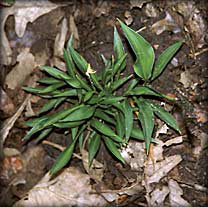
Hosta 'Itsy Bitsy Spider' (right)
Smaller is Better, if....
We live in an age of smaller and smaller hostas being sold as plants fit to be planted in the garden. It is the hosta collector’s demand for a constant flow of new hostas at lower and lower prices that makes the whole introduction process spin faster and faster. This is not a bad thing if we can keep up, but some would say it is all spinning out of control. Fortunately, we have become very good at growing these new little prize possessions and most of them make it through the first year fine and live to a ripe old age.
All this accelerates the evolution of hostas, creating higher and higher selection pressures upon each new cultivar introduced. As a result most hostas stay in the market for only a small window of time. They are here today and sold out tomorrow. Some hostas exist in the trade for only one season. Only the most marketable, in the eyes of nursery folks, are produced for a longer period of time. As a result, if you want that new special hosta, you have to buy it small and grow it up yourself.
I have tried to buck this trend the best I could, still introducing hostas with large mature root systems. I would like them to have bloomed and gone through a dormancy or two, but supply and demand does not always allow this. In any case, you still get the biggest plant we have in the nursery when you order and if they are smaller than I would like, I send two.
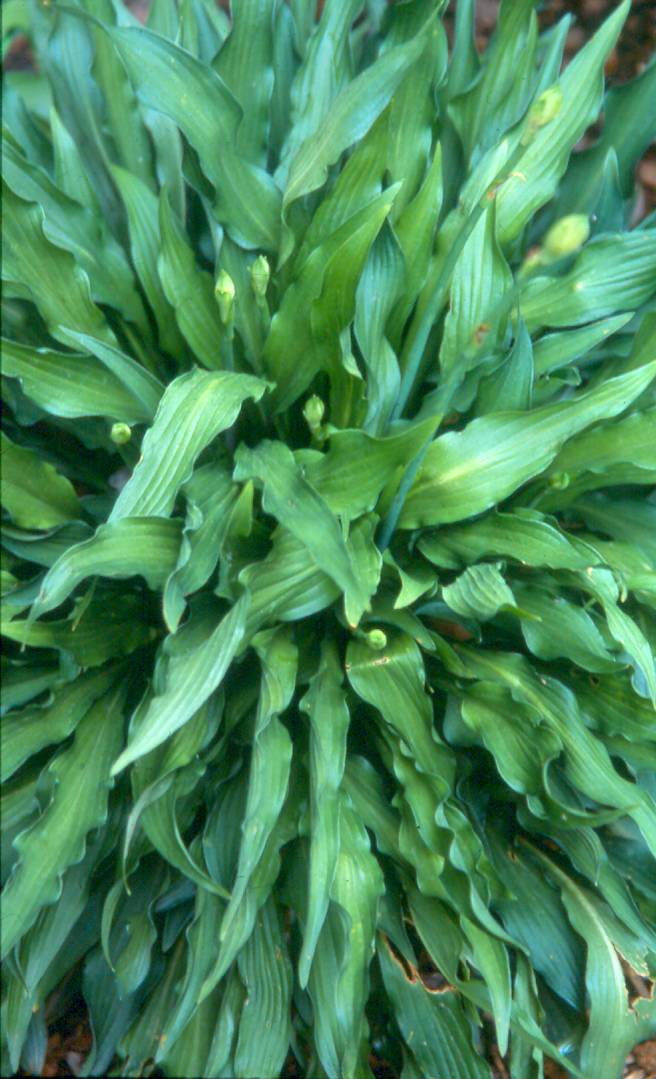
Hosta 'Lizard Lick' (right)
As a result of living in this high speed world of less than mature hostas, my customers frequently hold up a hosta, unknown to them, and ask me, “How big will this hosta get?” If they are standing next to me, and even sometimes if they are on the phone, I usually gesture with my arms making a basket and reply, “About this big.” If I get an unsatisfied look, then I state it is small, medium or large. Unfortunately, this answer needs some point of reference and works fairly well for AHS Hosta Show judges but not so well for the gardener with a specific spot in the garden in mind.
So then comes the simple question that requires such a complex answer, “How tall does it get?”
I could guess, or make up a number, and I am sure the customer would be pleased, but I would not. Hosta height, despite what you read on picture tags, catalogues and reference books, is not a constant. It is the most variable of all hosta characteristics, more so than leaf size or clump width. Environmental factors, nutrition, the number of divisions in the plant, and even its location on the planet all cause the height of a single hosta cultivar to change in time and space. To answer, “How tall does it get,” I must myself now ask a series of questions and a simple answer becomes a five minute hosta classroom discussion.
Pick a hosta, any hosta. It will be taller in the shade than twenty feet away in a sunnier location. Bright light for most of the day can make a majestic hosta become almost flat. The difference in height may be six inches or more. It is that old light intensity thing, plants stretch in deep shade and spread out in the sun. It is not just the leaf petioles that lengthen or shrink because of light intensity but the hosta leaf blades become more narrow and smaller in more sun, also.
Light intensity varies globally with latitude also. The same hosta in Georgia may be as much as half as tall as it is in Minnesota, (much to the chagrin of the folks in Georgia!) Hosta width however, varies much less with latitude and is more dependent of maturity of the clump, (number of divisions), and amount of moisture. I believe the tallest hostas that I have seen were in Spokane, Washington. I came home from that National Convention and was appalled how short my best clumps were. I remember yelling at them, “Stand up! Grow!” They ignored me being the sane, courteous creatures that they are.
As hostas mature and produce more and more divisions they naturally increase in height. As the plant widens, the leaves in the center of the clump have really no where to go but up. Moisture can also change the height of a mature hosta dramatically. Spring weather with constant rain will produce abnormally tall and lush hostas due to both the abundant moisture and reduced number of sunny days. Drought during the Spring period of rapid growth will dwarf mature hostas for the rest of that growing season no matter how numerous those summer showers are.
So you see, estimating the height of any hosta is a complex process, hence my small, medium and large usual answer. We, however, now live in a hosta world of picture tags, as much as I hate it. Customers should buy hostas not tags! Regardless, tags are here to stay, the bigger the better, and each tag requires an universal hosta clump measurement, height and width. Some tag makers try really hard to have measurements that mean something, relatively anyway. Others think all hostas are about the same height, say 18 inches. If you translate these guesses into your own concept of small, medium and large, then the numbers can be useful. If you believe them to be totally accurate because they are in print, then you could be very disappointed. You should also stay off the Internet, that could be even more dangerous.
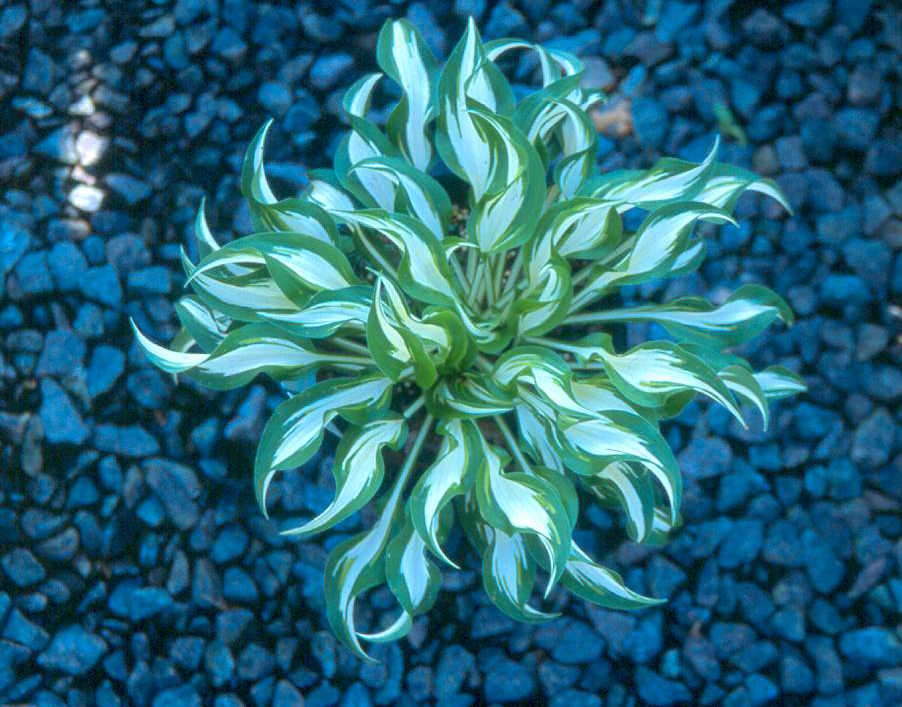
Hosta 'Hideout' (right)
In summary, I suggest you put your faith in hosta widths when planting your garden and let the heights work themselves out. I am sure that at least one year in five your hosta’s height will match the number on the tag, even in Georgia, when the floods come that one April. In hostas, big should be equated with width, not height.
By now, my customer has a glazed look on her face and a polite smile. It is time for her answer. I spread my hands apart one over the other about a foot and a half apart and say, “About this high.” Most times she will buy the plant nonetheless.
Editor’s Note: Because of popular harassment, this year I have listed height and width measurements for my newest hostas. These “guesses” are for hostas 3-4 years in the ground and are attempts at national averages. If you live in Minnesota think bigger, in Georgia think a little smaller, maybe. Hopefully, they will match your clump in the garden during your hosta’s immortal life. I fear I may soon have to produce my own picture tags and these measurements will become permanently etched in plastic.